What I recommend approving at the previs stage
Maria Petrova, co-founder and lead director at NOSLOP
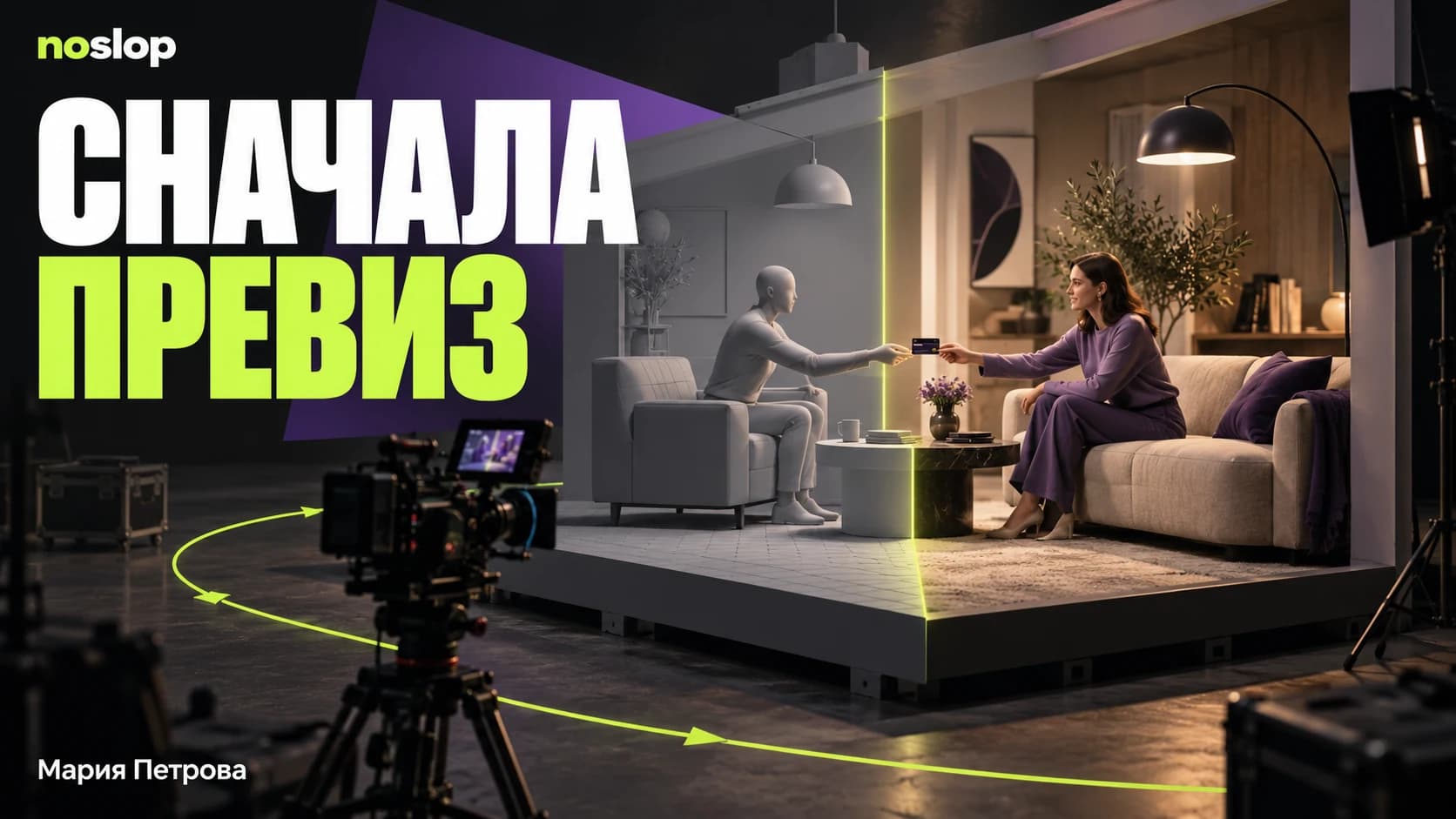
A film in previs can look unfamiliar: grey walls, simplified figures and very few details. I value this stage because it gives us space to examine the staging calmly. Without beautiful skin, fabric textures and highlights competing for attention, we can clearly see whether a character has time to complete an action and whether we understand what happens between shots.
Previs is a preliminary model of a scene. At NOSLOP, we use our own 3D Previz Studio system for this work. We place characters and objects in space, choose the camera position and test its movement. We then assemble the shots into a rough sequence of the required length. The concept acquires distances, directions and timing.
Imagine a simple scene: a character picks up a package from a table and passes it to someone opposite. On paper, it is one line. Staging it immediately raises questions. Which hand holds the product? When is the front visible? Does the other character obscure it? Where should the camera be so the viewer understands the handover on the first viewing? The answers affect several shots at once.
During approval, I suggest watching the whole scene first. Is the motivation clear? Is there enough time for a responding glance? Does an object unexpectedly switch hands across a cut? Then we return to individual shots and refine their scale. Sometimes a wide shot is more useful than an impressive push-in: it shows both the product and the other person’s reaction.
We check speech and sound separately. If a short shot needs to contain opening a package, speaking a line and smiling, I want to hear that line in the rough cut. Otherwise, the timing only seems sufficient until a real voice is added. A pause between words also takes time and may define a character more strongly than an extra gesture.
Previs also has clear limits. A grey object does not mean the product will look that way. A simplified face does not approve the actor’s appearance. In our workflow, previs primarily covers geometry, camera, composition and movement. Appearance, costume, lighting and colour are approved through the appropriate visual materials. I always explain exactly which decision I am asking people to make.
If both horizontal and vertical versions are required, they should be considered here too. Two characters at opposite edges of a wide shot may not fit a vertical frame. That means a different composition or an additional shot is needed. In a preliminary model, this becomes a clear staging question that can be discussed before final material is created.
After approval, the team has a shared reference: shot order, character positions, camera paths and action timings. We can return to these decisions when reviewing generations. For me, successful previs means the agency and production team understand the future scene in the same way and know exactly what they need to create.